|

Symposium 2001/27
10 July 2001
English only

|
Symposium on Global Review of 2000 Round of
Population
and Housing Censuses:
Mid-Decade
Assessment and Future Prospects
Statistics
Division
Department
of Economic and Social Affairs
United Nations Secretariat
New
York, 7-10 August 2001
The role of information technology (IT) in disseminating
statistics:
Focusing user needs and expectations
Sten Bäcklund
In this paper we
will make a non-technical approach to the present and future use of information
technology (IT) for disseminating statistics. We will focus on user needs and
expectations and how this will decide on how dissemination strategies are
formed and implemented. We will discuss recent IT practices for dissemination
but also point at trends that will have an impact on how a statistical
organization must adjust in the future. We will also concentrate on how the use
of Internet techniques and methods can facilitate meeting public demands and
what is needed to do so.
Identifying
ways of marketing and disseminating information has always been important to
statistical agencies. With the advent of the Internet it became possible to
reach the public within a totally new framework, and the technologically most
advanced national statistics offices launched their first web sites in the
mid-1990s. Since then the Internet has grown beyond imagination and you can
hardly attend any conference, seminar or workshop where Internet solutions are
not discussed or promoted.
In this
context we will continue from the findings of two events held under the
auspices of the UN Statistics Division (UNSD) and with a bearing on our further
discussions on the combination of dissemination and IT.
Referring to
the conclusions from the UNSD Seminar on User Relations, Marketing and
Dissemination of Official Statistics (UNSD, 2000) directed to CIS (Commonwealth
of Independent States) countries, we can identify some salient points:
q The
importance of quality output in terms of relevance, accuracy and timeliness;
q Good
media relations;
q Identification
of important user groups;
q Pricing
policy; and
q Information
sharing on good practices and examples.
The seminar focused on reaching
and servicing customers, addressing the needs of the private sector and on ways
of approaching media and the public at large.
The second ESCAP
workshop (United Nations Economic Commission for Asia and the Pacific)
on Census Data Processing, Storage and Dissemination (UNESCAP, 2001) was held
in Bangkok in March 2001.
Of special interest here are item 4 of the agenda titled “Translation of data
users’ needs into dissemination strategies” and item 5 of the same agenda,
“Innovative technologies for data dissemination technologies”. Papers were
written and introduced by representatives from the Australian Bureau of Statistics (Hardy, 2001a
and Hardy, 2001b) and Statistics New
Zealand, (Archer, 2001), while two country papers on census dissemination
were presented (Viet Nam and Cambodia).
From the vendor side Beyond 20/20,
Space-Time Research
and Statistics Sweden
were invited to show their products.
The workshop
recommendations were numerous and, even if quite a few are relatively detailed,
the sheer number shows how important the area is considered. The following list
gives a snapshot of major topics on IT/dissemination and refers to the numbered
paragraph in the final report:
q Use
public-domain software, mainstream solutions, off-the-shelf packages [76];
q Start
small, think big in Data Warehousing and On-Line Analytical Processing (OLAP)
[94];
q Provide
analytical flexibility, client customization [95];
q Metadata
management [97];
q Low-cost
GIS solutions [101];
q User
contacts/consultations [102];
q Monitoring
changes in user population [104];
q Prototyping
for user acceptance testing [105];
q Attractive
packaging, advertising, public relations and other promotion [106];
q Security
concerns [107];
q Link
to other agencies in the region [108];
q Adapt
disseminating media to user/community profiles [109];
q Internet
is strategic [111];
q House
policy and guidelines [112];
q Improve
customers’ ability to self-service [118];
q Monitor
web site traffic to identify key user groups [119]; and
q Explore
XML [125].
We will refer later on to the
findings of the two meetings in their context.
1.1
Identifying users and stakeholders
Traditionally,
main users of official statistics are considered to be different governmental
bodies at the central and local levels, large businesses, regional or
international agencies and research institutions. To some extent, this can be
recognized as a result of how means have been allocated and channeled. But
things are changing. The fact that statistics are now being regarded as a
public good is partly an outcome of the change in dissemination of statistics.
The presence of the Internet makes the difference.
In this
seminar in Vientiane, we have seen how marketing strategies can be employed in
order to identify current and potential customers and then reach them (Spar,
2001). The role and influence of media and the public at large have also been
discussed (Ostergaard, 2001). The government has been identified as a key user
and stakeholder, while the importance of the private sectorhas been stressed. Recent practices of
dissemination in Asian countries have been presented (Marzan, 2001).
Reading
through the country reports to the ESCAP workshop
five major user categories stand out by area of activity:
q All
levels of government;
q International
agencies;
q The
private sector;
q Research
institutions; and
q The
public.
It is
worthwhile noting that the media were never recognized as a user group.
A different way of categorizing
is suggested by Archer (2001). He divides the users into:
- General Data Users
2. Analysis
Users
General data users are, for example, students, teachers, libraries
and small businesses who have simple data requirements but from a great range
of information. Needs are normally not known in advance. Analysis data users, on the other hand, are identified from their
complex data requirements on detailed variable and regional breakdowns, often
based on many datasets. Such users are, for example, governmental departments,
local authorities, researchers and VIP clients.
Another grouping is suggested by
Blanc et al. (2001) in a recent paper to the Quality
Conference in Stockholm in May where the authors classify users by type of
demand according to table 1:
Table 1. Public demand vs. private demand in official statistics
|
public/social demand
|
individual demand
|
|
“citizen”,
“society”
|
“customer”
|
|
long-term
demand
|
short-term
contract
|
|
Expressed by the political representatives
|
free
bargaining (market)
|
|
socio-political
dialogue; government setting priorities
|
contract between NSI
and individual partner
|
|
terms are not
(explicitly) specified
|
terms are explicitly
specified
|
At the same conference Linacre
(2001) makes a distinction between
- Members of the public,
students;
- Individual organizations who
seek a tailored service, e.g., on a commercial basis, or as members of the
media, etc.;
C.
Sophisticated users, e.g.,
researchers, financial analysts, analysts in policy departments; and
D.
Key users: central banks,
governmental bodies, international agencies.
(This
is also is similar to the Archer classification).
The main clustering characteristics are, then, the level of
statistical capability, level of interest, ways of access and partnership
willingness.
But in
whatever way we choose to describe and classify our beneficiaries, the
objective is to meet their needs and expectations in the best possible manner,
not only once but repeatedly. This is also the IT challenge: how we will set
about to use IT in order to reach our goals.
1.2.1
Provide
quality data
As has been
emphasized earlier in the seminar, users expect quality information. If this cannot be provided the user will
certainly stop asking for your data and try to find it elsewhere. A well-functioning
IT environment will without question make things easier. Quality is normally
defined in terms of accuracy, relevance,
timeliness, coherence and
availability without specific order.
Every now and
then there will be conflicts between factors. It is not always easy at the same
time to provide for accuracy and timeliness. Another example is coherence and
relevance: it would be convenient if corresponding statistics from different
surveys were the same or if aggregated monthly estimates and annual statistics
coincided, but this is rarely the case due to variations in definitions and
methodology.
In Annex 1 some underlying factors related to IT are laid
out. These factors are often encountered in less developed or emerging
countries.
There are
certain important aspects of disseminating information that are valid and do
not depend on the media of choice, whether it may be hard copy, CD or the
Internet, in order to meet the user’s expectations. One of the tools for doing
so is to provide for a good navigation
system.
If we use a
statistics web site as an example, this could be accomplished through standard navigation for the general
public and through a set of alternate
navigations that are available from a user’s perspective catering to
various target audiences. Most advanced are enterprise portals that are database-driven and often expensive to implement.
Likewise a retrieval application should preferably
accompany data disseminated on CD-ROM. Statistics Sweden distributed its 1990
census tables on CD at the same time providing the first PC AXIS version as an
exploratory tool. Often a GIS (geographic information system) application for
mapping statistics will be included. And even a paperbound report or a
statistical yearbook should at least come with a table of contents, search
index, table and diagram references.
There are
other matters relating to how information is packaged. When considering a
statistics web site, you might compare a first-time user with a person visiting
a store. You would certainly want him
to look at what products you have to offer, walk through the shop, buy and in
the end, most important, come back a second time!
Thus, try to
locate what you want to trade as high in the navigation structure as possible
and highlight news and press releases. Keep your web site alive! Place related
information close together or on the same navigation level and provide a site map.
Users want links to related information and you
should give the links but at a reasonable level. Sometimes you may find
(scientific) web sites overloaded with links to other sources of information,
and the risk is high that the user will wander away in cyberspace and not
return to the site from where she started.
Taking all
potential customers of statistical information into consideration, we must
remember that they constitute a heterogeneous group from, for example,
governmental bodies to enterprises, researchers and the public. This means that
any national statistics office must be prepared to offer optional ways of
retrieving information.
Preferred media
Even if the
web already is the major dissemination alternative for many agencies, there are
still users who will prefer hard copies, CD-ROM or even old-time floppies. To
date national libraries and archives often have had specific requirements on
the delivered media—e.g., microfiche, tapes or MO disks. Information exchange
over computer networks could also call for special handling in accordance with
agreed-on protocols.
With no access
to the World Wide Web, the user may still benefit from other Internet services,
e.g., SMPT for receiving information via electronic mail. In the end this is
one of the factors that the national statistics office must keep in mind when
designing, evaluating or changing its dissemination strategy.
Print-on-demand
Many users do
not want or need to have all the information that comes with a product. Some
just want to receive a summary or a set of basic tables while others have more
specific demands. Instead of having to buy or download, e.g., a complete report
or statistical yearbook, the user may prefer to specify want he wants and then
have it printed either by the agency and then mailed or downloaded and printed
by the user himself.
Statistics for further analysis
Researchers or
planners are often interested not only in macrodata but also in the underlying
micro-information. Provided that measures for ensuring integrity are taken,
especially when dealing with sensitive data, these data could be disseminated
through electronic networks such as the Internet. Additional security may then
also be needed—for example, SSL encryption to prevent unauthorized access.
The user
should also be given the opportunity to specify preferred data formats
at the time of delivery to facilitate further analysis.
1.2.4
Recognize
and adapt to new technologies on the user side
New technologies are emerging
all the time. One of the latest trends in disseminating data is by Instant Messaging systems based on,
e.g., SMS and WAP.
Many statistical organizations are already using these methods to disseminate
critical business information to the private sector and the media—for example,
price statistics or financial markets indicators. So now if the user community
wants these services (which you will know from your focus groups or user
contacts) you should be prepared to provide for them. And in the future, solutions based on advanced and high-speed
connection (GPRS, HSCSD,
Bluetooth) will grow
in importance.
1.3
Outlining a dissemination strategy
On the
assumption that current and potential stakeholders and users are identified, in
outlining a dissemination strategy for a national statistics office, the
following questions must be asked:
A. What type of information should be provided?
Examples: data, metadata, administrative information, methodology,
statistical activities, research results
B. What are the possible means and ways of
dissemination?
Examples: paper, hard copy, diskettes and the like, CD, web pages,
traditional mail, electronic mail, discussions, workshops, seminars,
conferences, bi- or multilateral projects, networks
C. What will be the interventions and what are
the assumptions?
Examples: web-site creation, equipment and application costs,
maintenance, coordination of activities, security and legislation
Chapter 2.2 on users’ needs and
expectations stresses the importance of quality information and how data should
be presented in a clear way and in a medium of the user’s choice.
Based on the
country reports on census activities to the ESCAP workshop
the following simplified “translation” of users’ needs into possible
dissemination strategies was made:
Figure 1.
Outlining dissemination based on country reports on census activities

User groups
are dimensioned the traditional way, user needs relate to census information,
primary data are obtained through censuses and surveys and, finally, contents
and media are linked together. Any dissemination strategy could then be
considered as a realization of a subset of
users, needs, contents and media, and with the time dimension added.
If the
national statistics office considers its web site as the primary target for
disseminating activities, as is the case in many countries, users will naturally
be categorized in accordance with what has been discussed earlier in chapter 2.1.
We will not
elaborate on conventional methods for disseminating statistical information since
this is outside the scope of this paper. It should be mentioned though that
most national statistics offices have in the past installed printing offices to
provide for printed output, e.g., reports, press releases, yearbooks and so
forth, with often high costs for acquisition and maintenance of equipment.
Today the
needs for in-house publishing capacity are diminishing since there are
dissemination alternatives now available that were not available in the past.
Outsourcing printing when called for has also often proved to be
cost-effective.
Other ways of
disseminating information have been and still are workshops, seminars and
conferences as well as through regional and interregional projects.
Electronic
media have been a first choice for dissemination for a number of years. We
could say that this was becoming a true alternative with the introduction of
personal computers and networking, even if data had been transferred via
magnetic tape between mainframe installations since the 1950s.
Exchanging
data on floppies (5 1/4 “, 3 ½ “) and in the most popular PC formats became
common during the 1980s. In 1989 a process was developed with which a CD could
be directly written by means of a laser beam. The way for the self-creation of
CDs was opened. The CD is an ideal medium for distribution of information of
any kind (text, images, sound, data and programs). Equipment for burning
CD-ROMs is becoming more and more inexpensive and this method is therefore
within reach even for national statistics offices on a very low budget, as well
as for customers. Along with relatively low production costs, it provides high
memory capacity with direct access and a long lifespan, and is still without
competition, even when you only have low production numbers. (For this reason,
a majority of all PCs today are already equipped with a CD-ROM drive).
Thus CDs are
frequently used for dissemination of statistics since not only can (compressed)
data be stored but also retrieval applications, e.g., for tabulation,
drill-down analysis and GIS.
In the
mid-1990s national statistical agencies started to create their first web
sites. In the beginning, and with the still undeveloped software available, the
ambition was often limited to “being noticed” and this was accomplished through
static HTML pages organized in strict hierarchical navigations structures.
Pages were often arbitrarily updated except for statistics that were published
on a regular basis, such as price indices or short-term business indicators.
One common
characteristic was that the information provided on the web site was primarily
what had been decided by the producers.
The web site was not user-driven in
the first place. The reasons behind this were often scarce staff resources and
a “wait-and-see” view on the new technique.
With the
unprecedented growth of the Internet during the last half-decade it has become
obvious that it will be the main channel for dissemination for any statistical
agency. The Internet will encompass both the conventional methods and the new
ones and will change the strategies of dissemination in a substantial way.
1.4.1.1
What should
be part of an Internet Policy?
It must be
remembered that establishing and maintaining a web site as the main
dissemination platform for a statistical agency will be a long-term
undertaking. It is therefore important that an Internet Policy be outlined well in advance of implementing any
kind of web infrastructure.
First, we
refer to chapter 3.1 where the
dissemination strategy is discussed.
The answers to questions A (on contents) and C (on interventions and
assumptions) will form the cornerstone of the agency’s Internet policy.
In the next
step security issues should be
addressed. You should not go for web-site hosting prior to a thorough security
assessment, since this will decide on, e.g., if the hosting should be
outsourced with an ISP (Internet service provider) or done in-house and what
security layers should be implemented in order to secure your data.
Following these steps a plan for implementing the web site
should be designed. It will now be decided what resources will be needed, how
funds should be provided and so forth.
Furthermore,
you must decide on how the web-site support should be organized and how staff
training should be done.
Finally, production rules must be set wherein
updating, upgrading and maintenance are covered.
1.4.1.2
A
dissemination strategy: the case of Statistics Sweden in brief
At the end of
1999 a board decision was taken, stating that from 1 April 2000
q All
official statistics produced under the responsibility of Statistics Sweden
should be stored at the macrolevel in Sweden’s
Statistical Databases. These statistics should then be made available to
the public. One of the information channels for this purpose should be the
Statistics Sweden web site;
q All
official statistics under the responsibility of Statistics Sweden and printed in Statistiska Meddelanden (a series of reports) should be available
on the web site. They should be standardized by the use of templates and
print-on-demand should be offered (through download over the web);
q All
other press releases and a set of the most wanted statistics should also be
published on the web site by subject matter area/product in a standardized
form; and
q Under
conditions outlined above, official statistics may also be disseminated in
publications and yearbooks.
Statistics
Sweden’s Internet Policy sets out to
achieve these goals by maintaining a dynamic web site and engaging staff at all
organizational levels in keeping the site up to date. Strong measures have been
taken in order to secure the in-house environment and the statistical
databases. Extensive training schemes have been introduced and the agency
applies mainstream technology and methods. See also chapter 3.2.3.4.
1.4.1.3
Contents
What should be
published on the web site is first and foremost an issue for the top-level
management of the national statistics office even if, e.g., the subject-matter
departments will be the executing units. It must also reside with the leaders
to decide on data integrity, security matters related to data transfer and what
rules to be followed while authorizing the site.
1.4.1.4
Infrastructure
The
infrastructure for the web site is to a great extent dependent on what your
ambitions are. In a modest situation you might well be satisfied by outsourcing
everything with an ISP, retaining control only over updating the web site
remotely. This is not uncommon for small agencies that cannot afford either the
equipment (server, firewall) or the backup and 24-hour availability. In any
case, before starting to establish a complete in-house environment for your web
site you should always make a cost-benefit analysis not excluding such
important things like the needs of redundancy (e.g., backup servers) and staff
competence.
1.4.1.5
Security
Security is
always an important concern. It covers the extent to which you are prepared to
retain data integrity, e.g., by way of implementing redundancy and firewalls. A
risk analysis should always be done
in order to identify steps needed to prevent unauthorized or unintentional data
damage.
1.4.1.6
Training
A staff
development programme should be established covering how to implement and use
mainstream software for creating web pages and multi-layered web applications.
Even with apt staff, you cannot lay the responsibility on them to learn things
on their own. Commonly those involved are occupied with day-to-day work and you
need to provide the time needed to attend courses, workshops or seminars.
1.4.1.7
Sustaining
a quality web site
Without strict
rules on how the web site should be designed and maintained—for example, what
software should be used or what standards should be applied—there is a great
risk that it will deteriorate quickly. It is therefore important that there is
a tight web-site management with restrictions on what is allowed and by whom.
In most cases the webmaster or web coordinator will be solely responsible for
what is published on the site and how it is done. To assist them, you might
want to attach experts in different areas, e.g., language, design and layout,
multi-media and application developers. Steering groups or committees will also
be needed to decide on contents and to guide the webmaster in her work.
1.4.2.1
Hosting the
site
The Internet
Policy will point out in which way the web site should be hosted. As already
mentioned the site may well be outsourced with an Internet Service Provider (ISP) if this meets the dissemination
strategy needs, the level of security and possible cost restrictions. There are
also a number of free web servers available
on the net that provide limited disk space and some facilities to create
dynamic web pages with extracts from databases.
In any case
you will need an ISP if you intend to host your web site with your own
equipment in-house. There are, of course, a number of initial steps to be
taken. For example, you will have to implement the Internet Protocol (IP) in
your LAN (Local Area Network), since you will have to register an IP network
and a DNS domain name in order to access the web.
Virtual hosting can be an important
add-on alternative when launching web-driven multi-layered applications where,
e.g., electronic forms are used for collecting statistical data from
respondents like administrative units, schools or businesses or where
results/analyses from surveys, which are not part of the officially published
statistics, are disseminated to designated users, for example, government
bodies.
1.4.2.2
Established
products
As general
advice, you should always choose mainstream products when you implement your
website. There are no good reasons to go for cutting-edge technology or
inexpensive but unstable solutions.
For hardware this
implies brand servers and workstations for web developing, testing and
launching the site. You should choose well-known firewall and proxy techniques.
You should also study how other national statistics offices have done,
especially in your region.
The same
principle holds when you are deciding on web-enabling products. If you are
already on the Windows platform the natural choice would today be Windows 2000
Advanced Server that contains the components needed. If you are on UNIX or
LINUX platforms other products will normally be first in line. Likewise you
must make sure that your database solutions will fit into your concept.
You will also
need software for web design and creating web pages. There are a number
available, from simple HTML authorizing tools to Adobe Dreamweaver or Microsoft
FrontPage. Still, the ambitions of your dissemination strategy, as expressed in
you Internet Policy, should be able to guide your way.
1.4.2.3
Securing
the environment
In Annex 2 the principle behind securing
the Statistics Sweden’s web site is shown as an example. A firewall is implemented to protect the LAN from unauthorized access
resulting in the formation of three security layers that are physically
separated:
- The unsafe
network or what is here the same as the Internet
- The services
network located behind the (hardware) firewall
3. The
safe network which is the corporate
LAN
All incoming
traffic from the unsafe network will have to pass through the firewall. On the services
network, all Internet services offered are located, e.g., HTTP, SMTP etc. There
is no way for a visitor to reach the safe network. By the same token in-house
staff cannot compromise resources on the services network since they are only
accessed through dedicated applications that often are automated
In reality the
situation is more complex. So-called virtual
private networking is implemented in order to allow staff to access the intranet from the unsafe network. All
traffic to the official website must also go
via the firewall.
1.4.2.4
Site
testing
Put your site
under stress! Establish a schedule for testing your site and deal with latent
risks before unwanted problems arise. There are third-party providers who can
be contracted if you want to and can afford outsourcing these services.
1.4.2.5
Monitoring
activities
Keep track of
the events occurring on your web site! Monitor activities and obtain data on
hits from your ISP. Your own access log file can be very useful to you when
identifying your clients and which pages they visit. Especially subject-matter
departments show a great interest in how their statistics are used, not only in
the number of successful hits but also by whom and how often he returns. Try to
find out if you are really providing what customers want or if in some cases it
would be sufficient with, e.g., automatic e-mail or other solutions. To analyse
the log files you don’t need any fancy programs since log data come as plain
text and you can use your favorite statistical software to process them. But
remember that log files occupy disk space. If you want to archive log data you
should first compress it using Winzip or any other convenient software for this
purpose.
1.4.3.1
Web site
design
In designing
your web site you will have to consider who your intended users are and adapt
to their needs. This will hopefully result in providing your visitors a nice
portal to your organization. Virtual web sites as described earlier may be one
possible solution for meeting special demands. Statistics Sweden, as an
example, provides virtual hosting of web sites to meet specific target groups.
Figure 3
is borrowed from the Yale Style
Manual (Lynch and Horton, 1999).
Here users’ needs are classified in terms of “complexity” and “linearity” and
then mapped to navigation structures.
According to
this you will have to design your structure(-s) in a way that best corresponds
to the characteristics of your user groups, the ultimate goal being to give
everyone what she wants.
It is, of
course, important that you also try to standardize your web pages to conform to
layout decisions. There is a learning situation with all web sites. The user
will appreciate it if your navigation structure remains unchanged and if he can
expect related items to be found in similar locations throughout the site and
over time.
Figure 3.
Mapping users by “complexity” and “linearity” to navigation structures

Annex 4 gives the results from a recent survey
on visitors’ ratings of welcome page features by Knowledge Systems and Research
Inc., and published in the June 2001 issue of Internet World. Strikingly, ease of use and navigation is
considered most important by nearly 80 per cent of the respondents.
1.4.3.2
Static or
dynamic HTML
Dynamic
web pages are often server-script based
using CGI (Common Gateway Interface), ASP (Active Server Pages), JSP (Java
Server Pages) or other methods. The problem is that, e.g., ASP-generated HTML
(HyperText Markup Language) code, contrary to static HTML, does not cache. This
means that whenever a client returns to a previous ASP page it will be
re-created instead of returned from the client’s cache or the proxy. This will
take time, and if too many users are addressing your site concurrently, it may
occasionally break down.
The
right balance between static and dynamic pages should be established. It is
also important to strip generated HTML code from all unnecessary formatting in
order to speed up the traffic.
1.4.3.3
Downloads
A vital part
of your services should provide optional downloads of text information or
pre-processed data—for example, tables. The best way is to use the PDF
(Portable Document Format) format for text, which will retain all formatting
within the document. Other popular choices are Word documents and Excel
worksheets. If you use software developed in-house for data retrieval or
tabulation, you should always make sure that output formats can be read or
converted. Also remember to give file
sizes explicitly and next to download buttons so the user can estimate
download time and if it is worthwhile to go through this procedure.
1.4.3.4
The process
of publishing
Annex 3 is taken from an internal unpublished
paper from Statistics Sweden and shows how the agency organized its publishing
based on the decision made in late
1999. To begin with all statistics produced are stored into databases.
Thereafter documents are created in various formats using different tools
(e.g., dynamic database retrieval), converted to suitable formats depending on
usage, disseminated and archived.
1.4.3.5
Instant
messaging
Instant
messaging (IM) is becoming an essential form of communication, for both social
and professional exchange and, according to recent statistics, for over 140
million Internet users. In chapter 2.2.4
the notion was introduced and some implications described.
With IM you
can
q Target
information to specific users, or to groups of users, based on their
preferences;
q Promote
your products; and
q Alert
users when updates of specific web pages are available.
In societies
with an established infrastructure for electronic communication, IM may well be
considered a strategic issue for any national statistics office. It should be
kept in mind that IM services may be outsourced, thus eliminating the need for
an in-house IM-application development capacity.
1.4.3.6
The
importance of metadata
Establishing
an intermediate layer of metadata is an essential precondition for dynamic
retrieval of macrodata (or microdata) over the web. Users or visitors to a
statistics web site will search for information by choosing from lists of
indicators and information about those indicators. They will request
tailor-made tables and graphs based on metadata.
Metadata will
also make it easier to shield the underlying (primary) data from damage, since
they will be accessible only through applications. Another feature of metadata
is that they will be needed when creating data warehouses.
As an example,
PC-AXIS, which has been developed jointly by the Nordic countries and used by
many statistical agencies for disseminating statistics, is metadata-driven.
1.4.4.1
Establishing
a Data Warehouse for OLAP (On-line Analytical Processing)
The concept
of data warehousing (DW) has been around
for quite some time. There is a well-known and often-quoted statement by R. D.
Rogers: “We’re drowning in information and starving for knowledge” (Rogers,
1985), that would justify DW and at the same time puts it in a nutshell. DW is
founded on relational database theory and is normally delivered as a “black
box” containing tools for creation, administration, maintenance and output.
High-quality metadata is one of the prerequisites. Unfortunately it has been
and is still expensive to set up a DW for exploratory analysis and data mining,
and this may be the reason that only the best-situated national statistics
offices have been able to do it. A DW is by definition structured data
optimized for storage while the corresponding term, Data Mart, refers to data
that are optimized for output. Often they are treated as one concept, and we
will use DW only in that sense. Hence the main purpose of a DW is to
q Join
or merge data in advance from a large number of underlying sources instead of
doing this at run-time;
q Provide
an environment for data mining, i.e., searching and identifying patterns that
are not otherwise readily observed through easy-to-use statistical analysis and
reporting techniques in a client/server or tiered enablement; and
q Facilitate
responding to ad hoc requests from end-users and customers, preferably over the
Internet.
A web-enabled
DW for OLAP could be described visually in accordance with figure 5. You
could also include the underlying sources in the DW.
Figure 5. Implementing a web enabled Data Warehouse

In the ESCAP workshop
a paper was presented by Lim of Statistics Singapore that related to census data (Lim, 2001). In the
paper he distinguishes between a conventional
DW and a statistical DW. In
particular, a statistical DW is used by professionals, since the key purpose is
exploratory data analysis and it should thus provide maximum flexibility.
An interesting
trend in data warehousing is that the latest versions of RDBMS systems—e.g.,
Oracle, Sybase or MS SQL Server—have built-in facilities for web- driven OLAP
(On-Line Analytical Processing) applications, where users can utilize the
Internet to retrieve and download key information on-the-fly from large
databases in common formats for further analysis. The statistics software
vendors SAS and SPSS have long offered DW/OLAP solutions.
There are
also in-house benefits to consider:
q Common
data definitions are encouraged;
q A
single point of control;
q Metadata
layers are established; and
q Rapid
OLAP application development could be done.
Therefore at least an
assessment of advantages and disadvantages of implementing a DW should be part
of a statistical agency’s dissemination strategy.
1.4.4.2
Geographic
information system (GIS)
GIS software
and applications are often key tools in communicating information. Many vendors
today target specific user groups, e.g., interactive map creation/display over
the web for monitoring traffic or for locating shops and stores in the cities.
Many national
statistics offices have developed their own GIS software in order to meet their
specific demands, while others rely on off-the-shelf products like MapInfo.
1.4.5.1
Acceptance
testing
Whether you
use “old-fashioned” media for dissemination or the Internet, you still must
make sure that you actually provide what the user wants and in a way that is
suitable for him. It is often a good idea to test your product with a small
group of intended users or stakeholders to determine what adjustments need to
be done before launching in a larger scale. This may be easier said than done,
since end users tend to materialize only when there are complaints to be made.
But if a good
user/producer situation is established, acceptance testing should be encouraged
and experiences from this activity will be of great future value.
1.4.5.2
Monitoring
user community
In chapter 3.2.2.5 the importance of logging
the web site was stressed. In this way you will also be able to identify user
segments to some extent by the way they move around your site. But the web site
should itself provide valuable information. It is very easy to design a user
questionnaire for real-time response.
It may even at times be made mandatory to fill out a questionnaire for the
right to access and use a statistics product.
You should
always try to have ongoing communication with your key users since at the end
of the day good user relations are what counts.
An important
part of your dissemination strategy will be how (internal) information is
communicated to close partners. There are a number of ways in which branch
offices can be connected to the head office—e.g., provincial statistical units
to the national statistics office or the connection between the national
statistics office itself and others, such as governmental bodies or the central
bank. We will here discuss the most common at present.
Using Dial-Up-Networking
(DUN)
Remote access
of different kinds to branch offices has long been used for transferring data.
The requirements are modest. A stand-alone modem-linked PC on the one hand and
a receiving/transmitting server (using a modem pool) on the other are
sufficient. DUN will normally provide for RAS validation and gaining access to
and browsing network resources through some login procedure. There is a
security problem since most communication is performed over ordinary phone
lines with limited or no authentication and encryption. (In Windows NT/Windows
2000 this is a facility that comes with the operating system.)
Using Internet Services
Transport protocols – HTTP and FTP
The Hyper Text
Transport Protocol or HTTP is used for exchanging data over what we in everyday
terms call the Internet or the World Wide Web. It is via HTTP that web pages
are requested and retrieved. The File Transport Protocol (FTP) is preferred if
you are interested only in down- or uploading files since it is normally faster
and more reliable. An FTP server is typically installed at the same time as the
web server. Enabling SSL
or IPSec, data can
be encrypted prior to transmission. It is also possible to enforce
authentication/authorization through different types of certificates.
Electronic mail – SMPT
Simple Mail
Transfer Protocol (SMPT) is another Internet service that is provided for
moving mail from one host to another. In order to connect offices by using SMTP
you will need hardware on which mail services can be installed, e.g., Microsoft
Exchange Server. Mail clients, e.g., workstations will also need software to
administer in- and outgoing mail, such as Microsoft Outlook.
Figure 6. Using SMPT for exchanging mail over the Internet

Note:
An application proxy should always be implemented to protect the internal
network even if it does not appear in this figure.
Establishing secure WANs: Virtual Private networking
A Wide Area Network
or WAN is logically (and often technically) a concept for connecting different
Local Area Networks (LANs). A WAN based on TCP/IP can be considered a corporate
intranet and Internet techniques and methods can be applied.
Virtual
Private Networking (VPN) technology allows an agency to connect to branch
offices or to other agencies or organizations over a public IP network like the
Internet, while maintaining secure communications. To the user, VPN is a
“point-to-point” connection and how it works behind the scenes is to most users
irrelevant. The main advantage is that you only have to connect to local ISPs
to establish VPN, thus reducing the need of, e.g., modem pools and remote
dialing. VPN should therefore be considered as the major alternative for data
exchange over long distance.
The interest
in XML, or eXtensible Markup Language, is constantly growing. Since it
presents a standardized way for storing and delivering highly structured
information over the web, the implications on data interchange are apparent.
XML’s
structured syntax lets you describe virtually any type of information—from a
simple recipe to a complex business database—and sort, filter, find and
manipulate that information in flexible ways. It separates data and metadata
and is excellent for archiving information during long periods of time without
losing the possibility of recovering the data at any specific point. The latest
versions of databases include XML as an option, the latest generation of
browsers provide XML parsing, and statistical software giants like SAS and SPSS
support it.
As an example,
among SAS programmers, the number one reason to use XML is importing
XML-formatted information into SAS datasets. With systems receiving more and
more information in XML format, SAS programmers will use this facility to
access and analyse it.
The Meta Group,
one of the major analysts, predicts a continuous increase in the worldwide use
of XML. It will become the “conventional syntax for application development
within a year and the primary business-to-business Internet interaction within
two years”.
Figure 7 sketches how XML is used as an
intermediary in exchanging data between a national statistics office and
different users over a network connection.
Figure 7. XML for exchanging data

There is ongoing work within EUROSTAT to swap the current use
of GESMES
for XML in order to facilitate the exchange of statistical data.
In
a number of countries, lack of adequate legislation may prevent or at least
hamper web enabling of official statistics. This situation was recognized in
the UNSD Vienna seminar but no recommendations could be formulated to address
and possibly solve the problem.
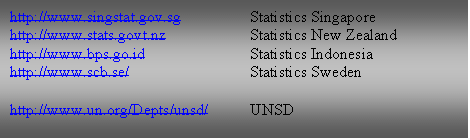
For this
section, the home pages of four statistics offices will be examined and we will
locate things that are meant to serve many of the purposes that have been
discussed. The sites have been chosen without any objective other than for
demonstration. As a comparison, the UNSD home page is also selected.
The
welcome page
Some statistics
Table
2 contains some facts about the welcome pages:
q Number
of “Page Down” keystrokes needed to see the whole page with different screen
resolutions;
q Approximate
number of objects that can be selected/pushed; and
q
The size of the page in bytes.
The
plus (+) sign indicates that an extra PgDn is needed to read (a few) lines at
the end of the page.
Table 2. Basic welcome page
characteristics for selected NSOs
|
Agency
|
No. of PgDn
(800x600)
|
No. of PgDn
(1024x800)
|
No. of objects that can be pushed (buttons, pictures,
text etc)
|
Page size
|
|
UNSD
|
2+
|
1+
|
19
|
15725
|
|
Indonesia
|
1
|
0+
|
22
|
13273
|
|
Singapore
|
2+
|
2
|
48
|
25602
|
|
New Zealand
|
0+
|
0
|
30
|
18766
|
|
Statistics Sweden
|
1
|
0
|
24
|
12079
|
What can be noted is that all pages are
relatively small and therefore fast to download even via a slow modem and that the
designs differ to a great extent in how much is stuffed into the page and how
much you then have to scroll to see the whole page. There are studies (for
example, Nielsen, 1996) that show that only 10 per cent of
first-time visitors ever scroll beyond the top of web pages.
There are many articles and books written on
web design that cover most of the topics that relate to user habits and
expectations. Here we will comment on just a few that could be of interest for
statistical agencies.
Features and utilities
Some of the
most important features are a site map,
a feed-back option and a search facility which allows searching
the site by keywords and/or text strings or searching the layers of metadata. If
you provide file downloads using the PDF format, you should also give the user
a chance to download the free Acrobat Reader if he wants to.
What’s new?
Most probably
your visitor comes to get the most recent information on your statistics. This
means that you should up-thrust news in your navigation structure and locate
news links at the top of the welcome page.
Contacts
Your visitor
will also need to know how to contact you. Therefore you would locate primary
contact information on the welcome page, e.g., an e-mail link to your webmaster
and a link to a page with more comprehensive contact and feedback
possibilities. It is also a good practice to give contact information on your
product pages.
Job opportunities
Why not give
your occasional visitor a chance to get a job within your agency? She may
actually have gone to your site in order to look for exactly that kind of
information. It will also save you money since you won’t have to rely on
advertising or other channels. Just provide your link where you might think
that potential future employees would look.
Courses, seminars
Your welcome
page gives a golden opportunity to promote your activities and your statistics
to key users and stakeholders by inviting them to courses and seminars.
Links to other websites
Links to other
websites are useful, especially if they identify your partners or point to
other statistical sources within the country. Don’t put too many links on the
page. The user’s temptation to follow a link may actually conflict with your
more basic interests—to keep him as what is often called “a stayer”.
Trivia?
Why not
lighten up your welcome page with something that encourages your occasional
visitor to return? As an example, Statistics Sweden (in the Swedish Edition)
offers a database of all first or last
names in the population by year and sex (lots of parents come) and a calculator
that discounts prices by index (find out what you really paid for your old
Toyota in current prices).
This
paper was prepared for a seminar entitled The Uses and Users of Official
Statistics: Seminar on User Relations, Marketing and Dissemination of Official
Statistics, Vientiane, Laos, 25-27 June 2001.
There
are many hyperlinks referring to external web pages in this document. In order
to use this facility you must be connected to the Internet. There are also
internal hyperlinks referring to chapters in the current paper. On the screen
hyperlinks are marked in blue.
Including
links has been done intentionally to show how the use of advanced navigation
may facilitate comprehension of disseminated information. You will need the
latest Word versions to be able to follow the links.
Normal
reading and printing of the document will not be affected. The printout format
is set to US Letter. Changing the output format may, of course, result in
unwanted text or diagram locations on the page.
Archer, D. (2001). Responding to
changes in users’ expectations. Paper presented at the ESCAP Workshop on
Population Data Analysis, Storage and Dissemination Technologies, Bangkok,
27-30 March.
Bäcklund (2001). Going on the net
with your national statistics: What is there to consider? Paper presented at
the ESCAP Workshop on Population Data Analysis, Storage and Dissemination
Technologies, Bangkok, 27-30 March.
Blanc, M., A. Derosières, W.
Radermacher and T. Körner (2001). Quality and users. Paper presented at
International Conference on Quality in Official Statistics, organized by
Statistics Sweden and Eurostat, Stockholm, 14-15 May.
Hardy, S. (2001a). Maintaining
relevance in an environment of change. Paper presented at the ESCAP Workshop on
Population Data Analysis, Storage and Dissemination Technologies, Bangkok,
27-30 March.
Hardy, S. (2001b). 2001 census
dissemination: a world side web transition. Paper presented at the ESCAP
Workshop on Population Data Analysis, Storage and Dissemination Technologies,
Bangkok, 27-30 March.
Lim, E. (2001). Setting up a data
warehouse—salient points for consideration. Paper presented at the ESCAP
Workshop on Population Data Analysis, Storage and Dissemination Technologies,
Bangkok, 27-30 March.
Linacre, S. (2001). Understanding
users and managing quality in a statistical agency. Paper presented at
International Conference on Quality in Official Statistics, organized by
Statistics Sweden and Eurostat, Stockholm, 14-15 May.
Lynch, P., and S. Horton (1999). Web Style Guide: Basic Design Principles for
Creating Web Sites. Yale University.
Marzan, C.S. (2001). Discussion
paper on assessment of the Asian practices on dissemination. Paper presented at
seminar on The Uses and Users of Official Statistics: Seminar on User
Relations, Marketing and Dissemination of Official Statistics, Vientiane, Laos,
25-27 June.
Nielsen, J. (1996). Top ten
mistakes in web design. Sun Microsystems.
Østergaard, L. (2001).
Development and implementation of a media policy. Paper presented at seminar on
The Uses and Users of Official Statistics: Seminar on User Relations, Marketing
and Dissemination of Official Statistics, Vientiane, Laos, 25-27 June.
Rogers, R.D. (1985). New York Times, 25 February.
Spar, E.J. (2001). Customers.
Paper presented at seminar on The Uses and Users of Official Statistics:
Seminar on User Relations, Marketing and Dissemination of Official Statistics,
Vientiane, Laos, 25-27 June.
United Nations, Economic and
Social Commission for Asia and the Pacific (2001). Final Report. ESCAP Workshop
on Population Data Analysis, Storage and Dissemination Technologies, Bangkok,
27-30 March.
United Nations, Statistics
Division (2000). Summary report. Seminar on User Relations, Marketing and Dissemination
of Official Statistics, Vienna, 11-14 July.
VENDORS
Beyond 20/20. http://www.beyond2020.com
SuperStar. Space-Time Research. http://www.str.com.au/index1.html
PC AXIS. Statistics Sweden. http://www.scb.se/eng/databaser/ssd.asp
Annex 1.
Some indicators on how IT relates to quality
|
QUALITY
FACTORS
|
INDICATORS
|
|
Accuracy/
Completeness
Reliability
Relates to IT mainly in
the way of how data are collected, edited and stored
|
·
Variables
included in survey questionnaires are left unattended and only major
indicators are computed. This results in loss of information that could be
used for e.g. within-record comparisons or later macro editing or analysis.
·
Short planning
perspective regarding designing or changing surveys does not give enough time
for testing e.g. the questionnaire through pilot studies.
·
Since statistical information often is collected from administrative
aggregate sources compiled by e.g. line ministries, NSOs have limited ways of
controlling the quality of the underlying primary data which in turn will
affect final reporting. This fact makes it almost impossible to do in-depth
statistical analysis of data. The same might be true for in-house reporting
systems where they rely on aggregate reporting from underlying bodies e.g.
provinces and districts.
·
Unintentional modification/destruction of data may occur when there
is a lack of good data management e.g. different versions of the same data
are used for editing without coordination.
|
|
Timeliness
Relates to IT in how data
are captured, edited and stored into ready-to-go statistical databases and in
what way these data are later processed and disseminated
|
·
Staff shortage in certain sectors means a heavy workload on a few
employees, which in turn will affect timely reporting.
·
Financial constraints limit the staff number in different
departments, units, divisions or sections. Other budget considerations hamper
computer equipment acquisitions and training in IT areas.
·
Statistical data are normally stored in computer data files residing
on different media instead of central databases.
·
Output databases are not created since no deadline for data editing
is given.
·
Lack of application developers and suitable software makes it
difficult to process and disseminate data in a timely manner.
|
|
Relevance/
Contents
A good IT environment in
itself cannot provide for relevant statistics but it can make life easier for
statisticians.
|
·
NSOs are not using channels of exchanging information to the extent
that could be done e.g. the Internet for sharing experiences and best
practices
|
Annex
1. Some indicators on how IT relates to quality (cont.)
|
QUALITY FACTORS
|
INDICATORS
|
|
Availability/
Accessibility
Relates
to a great extent to existing IT infrastructure and how it has been
implemented
|
·
Output databases are not available, instead input databases are used
for tabulation and analysis
·
Dissemination plans cannot be met due to lack of competence
·
Ad-hoc self service is not available i.e. doing your own analysis on
data
|
|
Coherence/
Comparability
Consistency
Relates
to definitions, to what data are collected, how it is stored and if time
series can be created
|
·
Data from different sources are often used to describe and analyze a
statistical problem. Basic definitions e.g. object, population, variables,
statistics and time references should then be the same in all sources. If not
the outgoing statistical quality will suffer and in worst cases make future
analysis impossible.
·
Time is an important factor. When definitions change over time depending
on end users’ conflict it will affect consistency
·
Databases containing similar information are not comparable from the
use of different models or RDBMS systems
|
Annex 2. Conceptual firewalling

Annex 3. The process of publishing

Annex 4. Importance of web design features

SMS (Short Message
Service) is available on digital networks allowing messages of up to 160 characters
to be sent and received via the network operator's message center to a mobile
phone.
WAP (Wireless Application Protocol) is a free, unlicensed protocol for
wireless communications that makes it possible to create advanced
telecommunications services and to access Internet pages from a mobile
telephone. WAP is a de facto standard that is supported by a large number of
suppliers. See also http://www.wapforum.org
GPRS (General Packet Radio Service)
is a packet-linked technology that enables high-speed (115 kilobit per second)
wireless Internet and other data communications.